Showing posts with label view. Show all posts
Showing posts with label view. Show all posts
Thursday, April 13, 2017
NTFSLinksView View NTFS symbolic links and junction points
NTFSLinksView View NTFS symbolic links and junction points

Starting from Windows Vista, Microsoft uses symbolic links and junction points of NTFS file system in order to make changes in the folders structure of Windows and keep the compatibility of applications written for older versions of Windows. This utility simply shows you a list of all symbolic links and junctions in the specified folder, and their target paths. It also allows you to save the symbolic links/junctions list into text/html/xml/csv file.
Using NTFSLinksView NTFSLinksView doesnt require any installation process or additional dll files. In order to start using it, simply run the executable file - NTFSLinksView.exe When you run NTFSLinksView, press the Go button, and then the main window will display the list of all NTFS symbolic links/junction points in your profile folder. If you want to view the NTFS links in other folders, simply type the folder path in the top text-box and press enter (or click the Go button).
If you want to scan your entire drive, type C: in the folder text box and choose Infinite subfolder depth.
Download NTFSLinksView
Go to link download

Monday, April 3, 2017
FBCacheView v1 03 View Facebook images stored in the cache of your Web browser
FBCacheView v1 03 View Facebook images stored in the cache of your Web browser

FBCacheView is a simple tool that scans the cache of your Web browser (Internet Explorer, Firefox, or Chrome), and lists all images displayed in Facebook pages that you previously visited, including profile pictures, images uploaded to Facebook, and images taken from other Web sites. For every Facebook image, the following information is displayed: URL of the image, Web browser that was used to visit the page, image type, date/time of the image, visit time, image file size, and external URL (For images taken from another Web site).
System Requirements And Limitations
- This utility works in any version of Windows, starting from Windows XP and up to Windows 8. Both 32-bit and 64-bit systems are supported.
- The following Web browsers are supported: Internet Explorer, Mozilla Firefox, SeaMonkey, and Google Chrome. Opera is not supported because it stores the JPEG images in Webp format.
- FBCacheView wont work if you configure your Web browser to clear the cache after closing it.
- Its recommended to close all windows of your Web browser before using FBCacheView, to ensure that all cache files are saved to the disk.
Start Using FBCacheView
FBCacheView doesnt require any installation process or additional DLL files. In order to start using it, simply run the executable file - FBCacheView.exe
After running it, FBCacheView begins to scan the cache of your Web browser and displays the list of all images loaded from Facebook Web pages. You may need to wait up to a few minutes until the scanning process is finished. After the scanning process is finished, you can also watch the image in the lower pane of FBCacheView, by selecting the desired item in the upper pane.
If from some reason FBCacheView fails to detect the cache of your Web browser properly, you can go to Advanced Options window (F9), and choose the desired cache folders to scan for each Web browser.
Columns Description
- URL:The URL of the image on Facebook.
- Web Browser:The Web browser that stores the specified Facebook image file in the cache.
- Image Type:The type of the image: Profile image, uploaded image, or external image taken from another Web site. For External Image type, the original URL of the image is displayed on External URL column.
- Image Time:The date/time of the image as returned by the Web server of Facebook. This column usually represents the time that the image was uploaded to Facebook.
- Browsing Time:The last time that the specified Facebook image was loaded by your Web browser.
- File Size:The file size of the image.
- Filename:The full path of the image filename in the cache of your Web browser.
- External URL:Displays the original URL of the image (Only for external images)
Download FBCacheView v1.03
Go to link download
Friday, March 24, 2017
SysExporter Grab data from list view tree view combo box WebBrowser control and text box
SysExporter Grab data from list view tree view combo box WebBrowser control and text box
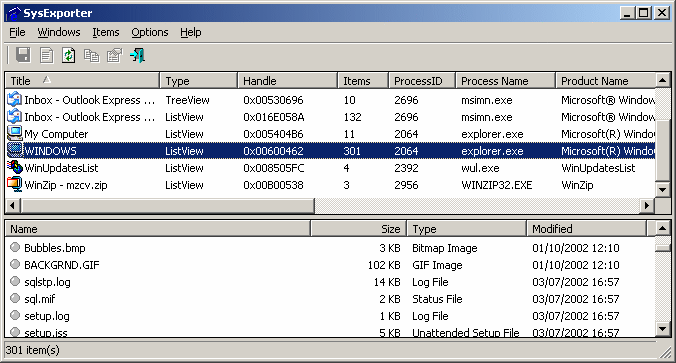
SysExporter utility allows you to grab the data stored in standard list-views, tree-views, list boxes, combo boxes, text-boxes, and WebBrowser/HTML controls from almost any application running on your system, and export it to text, HTML or XML file.
Heres some examples for data that you can export with SysExporter:
- The files list inside archive file (.zip, .rar, and so on) as displayed by WinZip or 7-Zip File Manager.
- The files list inside a folder.
- The event log of Windows.
- The list of emails and contacts in Outlook Express.
- The Registry values displayed in the right pane of the Registry Editor.
- The data displayed by SysInternals utilities (Registry Monitor, File Monitor, Process Explorer, and others.)
- The text inside a standard message-box of Windows.
- The HTML inside any instance of Internet Explorer.
Using SysExporter
This utility is a standalone executable, so it doesnt require any installation process or additional DLLs. Just run the executable (sysexp.exe) and start using it. There is only one exception: If you want to run this utility on Windows NT, you should download the psapi.dll, and copy it into the system32 folder. The main window of SysExporter contains 2 panes:- The upper pane displays the list of current opened windows that are available for export.
- When you select a single window in the upper pane, the lower pane displays all data that you can export from the selected window. For example: If you select the My computer window in the upper pane, the lower pane will display the list of all your disks, and they are displayed in the original My Computer window.
Practical Example
Lets say that you want to export the list of all files in your C:Windows folder to Excel:- First, open the C:Windows folder (or any other folder that you want to export).
- In the top pane of SysExporter, find the window of C:Windows folder and select it. If you cannot find this window, try to refresh the list by pressing F5 key.
- After selecting the desired window in the top pane, the files list of this window will be loaded to the lower pane.
- Select the files in the lower pane that you want to export. (Press Ctrl+A in order to select all files)
- Press Ctrl+C in order to copy the selected items to the clipbaord. (The exported items are copied in tab-delimited format)
- In Excel, go the position that you want to put the exported data, and then press Ctrl+V to paste the exported data into your Excel worksheet.
Download SysExporter
Go to link download
Wednesday, March 8, 2017
ProcessThreadsView View process threads information On Windows
ProcessThreadsView View process threads information On Windows

ProcessThreadsView is a small utility that displays extensive information about all threads of the process that you choose. The threads information includes the ThreadID, Context Switches Count, Priority, Created Time, User/Kernel Time, Number of Windows, Window Title, Start Address, and more.
When selecting a thread in the upper pane, the lower pane displays the following information: Strings found in the stack, stack modules addresses, call stack, and processor registers.
ProcessThreadsView also allows you to suspend and resume one or more threads.
Using ProcessThreadsView
ProcessThreadsView doesnt require any installation process or additional dll files. In order to start using it, simply run the executable file - ProcessThreadsView.exe
After running ProcessThreadsView, you should choose the process that you want to inspect.
After you choose the desired process, the list of all threads is displayed on the main window and automatically refreshed on every threads change. When you select a thread on the upper pane, the lower pane displays extensive information about the selected thread, according to the options you choose under the Options menu.
By default, only Show Stack Strings option is selected, but you can also choose to show the stack binary values, stack module addresses, other stack values, call stack, and processor regsiters.
Be aware that if turn on all available options, the loading process of the lower pane might be quite slow.
Download ProcessThreadsView
Go to link download
Subscribe to:
Posts (Atom)